
Cookbook
Lecode Recipes
The following is the list of hands-on examples supported by the SGFM Team.
These applications are provided with Lecode code base and cover its main capabilities.
These will help you to familiarise with the code. There are other applications which will be publicly released in the future.
To run an example you will need to open a Terminal, move to the chosen folder and use the following command:
$ mpirun -np X /path-to-lecode-folder/bin/lecode inputfile.xml
Where X is the number of processors you want to use, path-to-lecode-folder is quite self explanatory and inputfile.xml is the XmL input file
located in the example folder.
The model has been applied to understand the relative importance of sediment supply over fault-controlled
accommodation space in controlling the along-strike variability in shelf-margin and upper slope architecture of the Bonaparte Basin (NW Australia).
Lecode allows the quantification of the range of:
(1) sedimentation rates;
(2) global shelf-margin subsidence; and
(3) local fault-induced subsidence values
necessary to reconstruct the 3D architecture of the shelf-margin delta and the Bonaparte Basin.
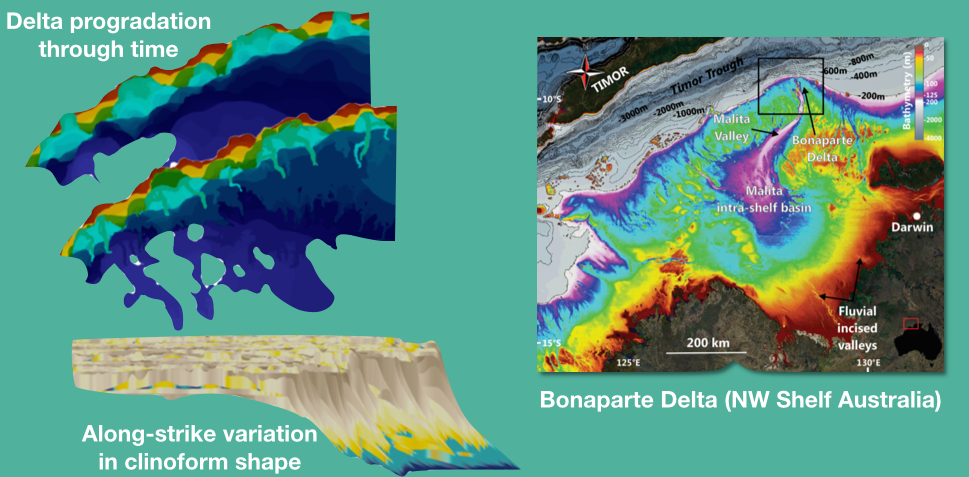
Here, the proposed example simulates the first part of the Bonaparte Delta progradation. To get more details on the results of Lecode Bonaparte Delta simulation see Bourget et al., 2013
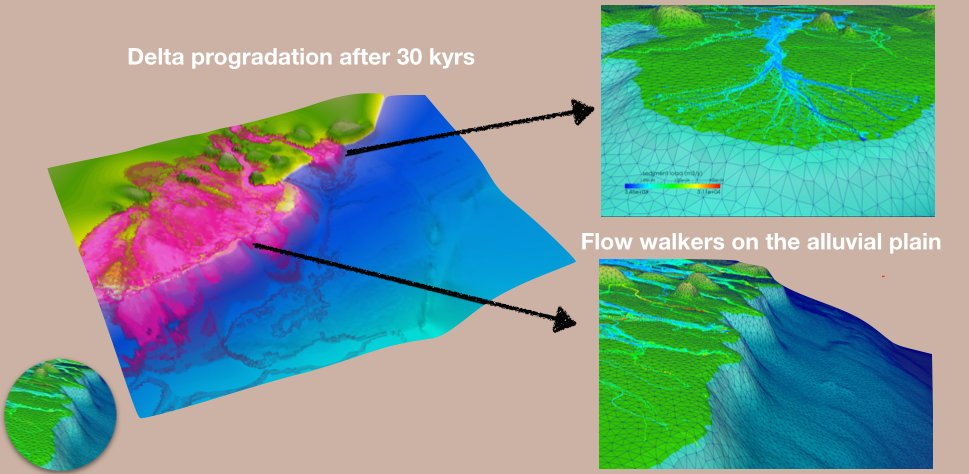
Download the delta input files (tarball).
folder: delta
specs: 227x145 cells, 400 m resolution, 30 kyrs
processes: uplift/subsidence + river + sea-level change
run duration: ~20 mn
The Ridge example illustrates the impact of contrasting bedrock erodibility on drainage
development and sediment yielding during the evolution of a plateau to a ridge in a bedrock landscape,
under imposed climate and uplift.
These two allogenic factors were set to represent a nonseasonal humid climate, with a mean annual rainfall
of 1500 mm, and a constant tectonic uplift rate of 5 mm/yr with a fixed-elevation boundary condition.
This fixed elevation boundary condition imposes a constant base-level but precludes the formation of a
piedmont at the base of the rising landscape.
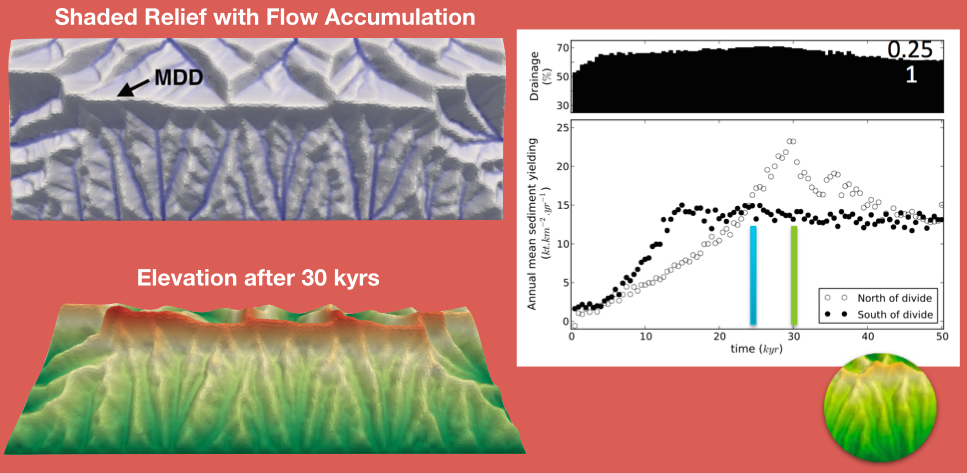
The experiment initial deposits is divided in a southern domain with non cohesive material and a northern one
with a basement material erodibility of 0.25.
Download the ridge input files (tarball).
folder: ridge
specs: 401x151 cells, 50 m resolution, 30 kyrs
processes: uplift (5 mm/yr) + rain + mass movement
run duration: ~50 mn
More Lecode simulations of the influence of contrasting bedrock erodibility on landscape dynamics are available in the following submitted paper ESPL Submission.
The source-to-sink system comprises all areas that contribute to erosion, transportation and deposition of sediments within an erosional-depositional system from catchment headwater to deep-marine basin floor fan.
Example of Lecode source-to-sink experiments
Download the source to sink input files (tarball).
folder: src2sk
specs: 298x314 cells, 250 m resolution, 500 yrs
processes: rain + mass movement
run duration: ~15 mn
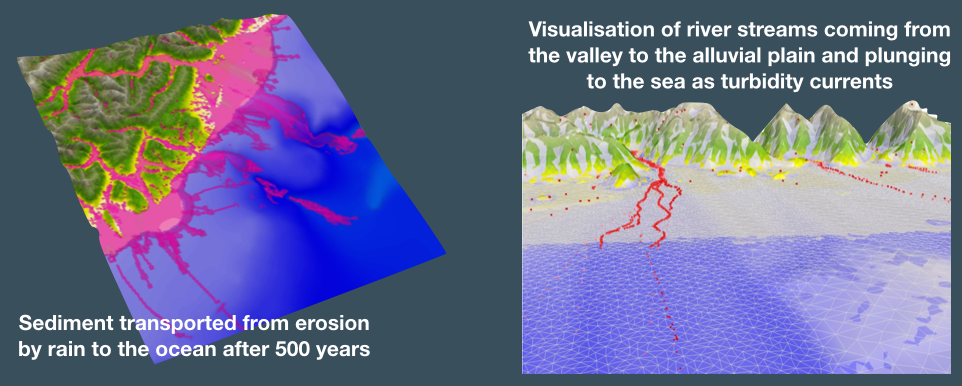
The depositional pattern for Lecode source-to-sink cookbook example should be similar to the ones shown below.
One of the SGFM developments effort is around the deformation of the lithosphere at intermediate time-scales and interlinks with surface evolution.
To study the nature of the interferences between dynamic topography, sediment transport/erosion, and
lithosphere instabilities, the Underworld model has been coupled to Lecode.
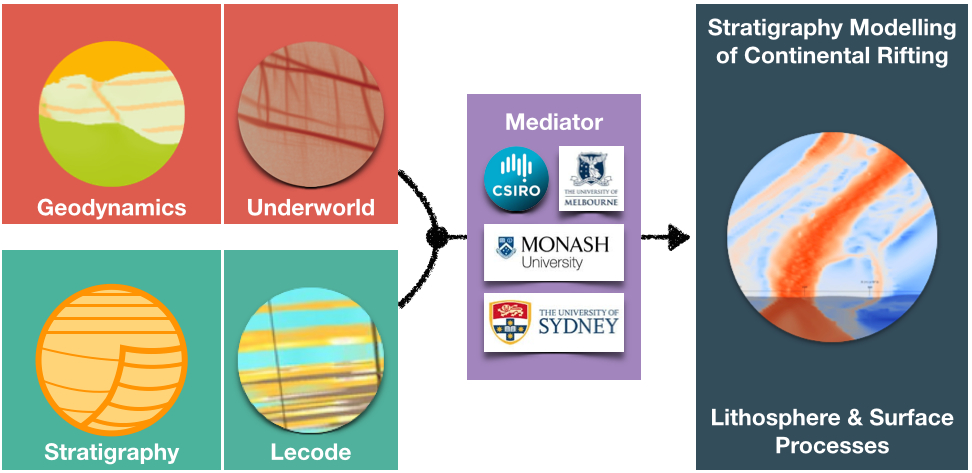
The application is part of a larger project on stratigraphic modelling of continental rifting.
To get a detail information on the coupling technique and the full example results, see
Mondy et al., 2013.
The full model presents an oblique rifting with heterogeneous sub-continental lithospheric mantle.
Two cratons of differing rheologies are rifted apart at 1cm/yr on each boundary.
Here, the provided example uses the displacement fields generated by Underworld and there is no
coupling and consequently no feedback mechanisms between geodynamics and surface processes.
Example of models ran by Luke Mondy in 2013 to illustrate the vertical only coupling mediator technique.
Download the rift input files (tarball).
folder: rift
specs: 161x161 cells, 1875 m resolution, 150 kyrs
processes: uplift/subsidence + rain + mass movement
run duration: ~25 mn